
Search Newton Property Records
Baker County holds the property records for Newton: deeds, assessments, tax rolls, and plats. City administrative material goes through Newton City Hall instead. One address and parcel key works across both systems. Keep the source date beside each result you save.
- Search the Baker Tax Assessor route by the Newton address, owner, or parcel/APN if the live form exposes those modes.
- Use the GSCCCA Baker name or book/page index to connect the owner to a recorded deed.
- Check the AssuranceGov tax-year result for bill and parcel context.
- Review any assessor map and recorded plat; no public Baker GIS viewer was confirmed.
- Ask the Newton clerk for existing permits, inspections, zoning decisions, code files, and address history.
For the full field-by-field sequence, see the Baker County property search. The city offers no searchable permit or zoning database. A records request is the reliable path.
Newton Property Record Custodians
Deeds, liens, plats, and surveys for Newton are recorded by the Baker County Clerk. Valuation and parcel records sit with the Baker Tax Assessor. The Tax Commissioner bills and collects. Newton's clerk handles city-held files such as ordinances, minutes, licenses, contracts, and any responsive permit or zoning material.
Baker County land records
Deeds, assessments, taxes, parcels, plats, and surveys are county-held.
Newton permits and zoning
146 GA Highway 91
Newton, GA 39870
229-734-5421
Newton Seat Before Incorporation
Baker County was cut from Early County in 1825. The seat moved from Byron to Newton in 1831. The Georgia Municipal Association roster dates Newton's incorporation to 1837. A record can therefore name Newton as the county-seat town. It could do so before any municipal record could exist. For early land, start with Baker County books and indexes. Byron works as an older location clue. Follow the legal description rather than assuming today's city boundary. The history helps you pick a repository; it never settles present jurisdiction.
Newton Zoning Has No Search
The city publishes its zoning ordinance as an 89-page document on the Newton Code of Ordinances page. The code spells out Newton's land-use rules in full. It offers no permit index, though, and no address search for building permits, zoning cases, inspections, site plans, or code enforcement.
| City record sought | Search field to provide | Verified access |
|---|---|---|
| Building permit or inspection | Street address, parcel, date range | City clerk request |
| Zoning decision or correspondence | Address, owner, case date if known | City clerk request |
| Business license | Premises and business name | Official form or clerk request |
| Code or site-plan file | Address, parcel, file type | Open Request Form |
Request existing electronic records as the office keeps them. Georgia's Open Records Act gives the city three business days for an initial response, though search, redaction, and copy costs may apply.
Newton Places in Property Records
Baker County publishes no list of named Newton subdivision plats or parcel prefixes. The official planning documents offer character areas and historic place clues instead. Treat those as context, not subdivisions.
| Neighborhood or character area | Era | How it appears in records |
|---|---|---|
| Downtown Newton | Historic core described in the 2006 plan | Six irregular central blocks before the 1994 flood; verify with deeds and plats |
| Residential character area | 2006 planning category | Land-use context, not a recorded subdivision name |
| Commercial Node | 2006 planning category | Search prompt for city files and road-oriented parcels |
| Floodplain and River Corridor | 2006 planning categories | Context tied to the Flint River and Ichawaynochaway Creek |
A character-area name is a good lead. Use it to locate plans, minutes, and newspaper references, then pull the recorded plat or deed for the actual parcel facts. The Baker County parcel maps page explains why tax lines and planning areas never replace a survey.
Newton's 39870 Address Limit
Newton addresses often carry ZIP Code 39870. That postal label says nothing about municipal boundaries. A mailing line can read Newton even when the land sits outside the city and answers to county systems instead. The city and GMA pages rely on the ZIP alone, and no official table maps 39870 to parcel ranges or city limits. Check jurisdiction differently. Start with the county parcel number and its legal description, then ask the city directly whether the address falls inside Newton for the record type you need.
Newton After the 1994 Flood
Water shaped Newton's records history. Courthouse flood damage hit in 1925, 1929, and again in 1994. The 1994 flood was the worst. Afterward, county functions moved into the former Baker County High School complex for about six years. A new courthouse opened in 2000. The old building later housed library and historical uses.
Floodplain facts matter for research too. The 2006 plan placed 54 percent of Newton territory in the 100-year floodplain and at least two-thirds of old Downtown Newton's six blocks in the hazard area. That can explain moved offices, vacant sites, altered land use, or old addresses that no longer match, though it never settles a current parcel's flood status.
Newton Historic Land Clues
The 2017 plan lists places worth searching. Named sites include the Baker County Courthouse, Notchaway Baptist Church and Cemetery, Pine Bloom and Tarver Plantations, Ichauway, Blue Springs, Pineland, Nilo, Pinegrove School and Cemetery, East Baker High School, and Clare Cross House. Treat them as search terms. None of the names proves current ownership. Match a place to a deed, plat, tax digest, or newspaper notice before pinning it to a parcel. The plan also names Patmos, Milford, Elmodel, Hoggard's Mill, and Hawkingstown. These are crossroads communities, not incorporated Newton neighborhoods.
Newton Library Property History
The Baker County Library sits at 398 GA Highway 37 in Newton. It belongs to the DeSoto Trail Regional Library system. Weekday hours run 2 to 5, and the phone is 229-734-3025. Ask the librarian about the branch's holdings. These may include Newton directories, newspapers, yearbooks, cemetery books, obituary files, or courthouse collections.
Digital newspapers offer another route. Georgia Historic Newspapers covers Baker County. Search Newton with an owner surname, a road, a church, a plantation, flood, or courthouse term. Save the title, issue date, page, and image reference. A notice can explain a property's history, but it does not prove present title.
Newton City Website Snapshot
Newton's city government details appear on the Georgia Municipal Association Newton roster. That listing confirms the city's incorporation, contacts, meeting schedule, and population.
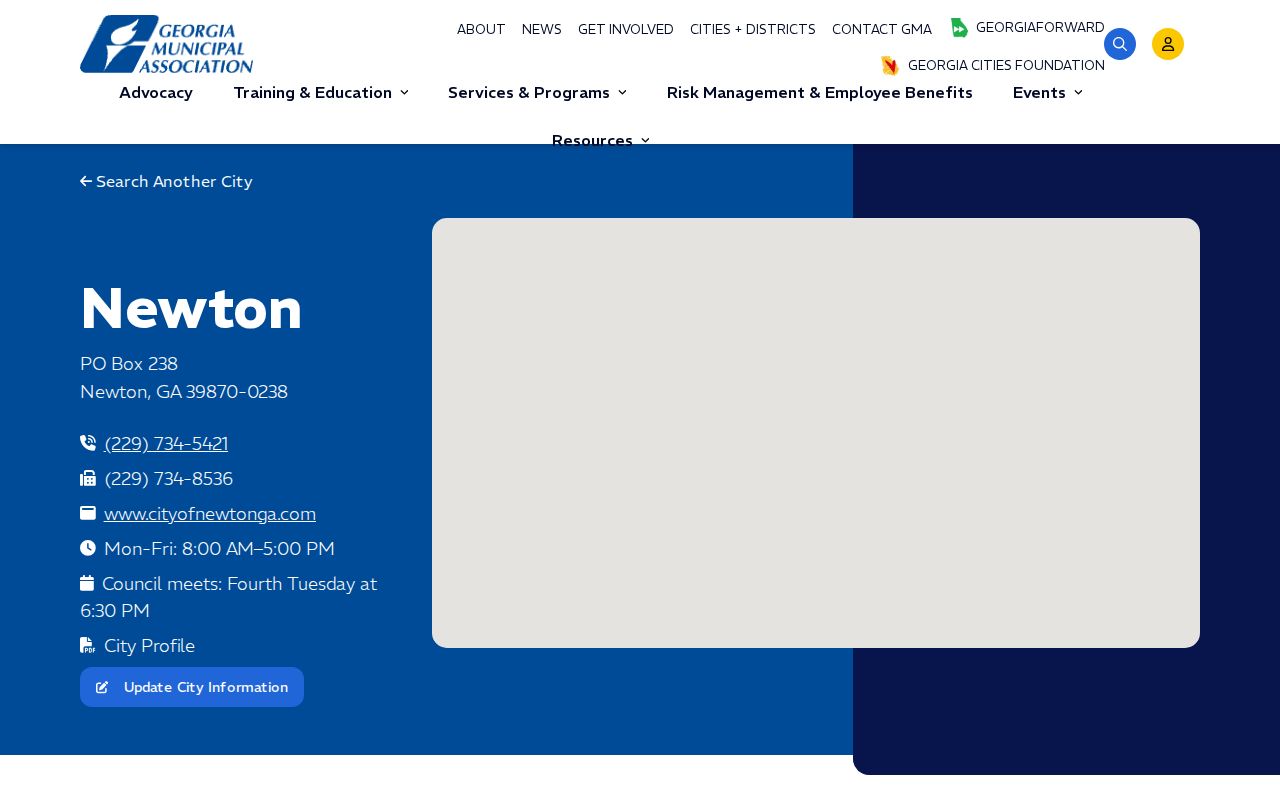
The roster confirms who the city is and how to reach it. Nothing more. It carries no deeds, no parcel boundaries, no assessment values, and no permit-search database, so property questions must travel a different road.
Newton Records Request Route
The city website posts an Open Request Form. It also posts a Business License Form. Neither spells out its fields. That means the request itself has to carry the details. Give the street address and the parcel number if you have it. Add the owner name if known, a date range, and the record types sought. A precise ask gets a precise answer from the clerk.
- Building permits and certificates of occupancy
- Inspection and code-enforcement notices
- Zoning approvals, variances, and correspondence
- Site plans and recorded address-history material
- Business-license records tied to the premises
The city does not have to build a new report for you. Request records in whatever electronic form already exists. Let the clerk flag lawful redactions or name the proper custodian. That keeps the request inside what the city can actually release.
Minutes and agendas work as a rough index when no case database exists. Search them for the address, the owner name, a road, a zoning term, or a project name. Then cite the meeting date and agenda item in the request. A council discussion can point toward a file. But it is not the permit, inspection, or final zoning decision itself.
Municipal court runs on a separate route. Newton publishes a court page. Yet it offers no public docket interface or spelled-out request steps. A city case may hold an address clue. Sealing, juvenile restrictions, expungement, and other lawful limits can still apply. Ask the clerk which existing public record can be released. Do not assume every case file is open.
Newton Value Records Stay County
Newton keeps no city assessor roll, parcel count, or value-trend table of its own. Property value stays a Baker County assessment question. The Assessor sets fair market and assessed values. The Tax Commissioner bills from the digest. Payment screens on the city website are not Baker County property records and should never be mistaken for county assessment data.
Georgia assesses property at 40 percent of fair market value for tax purposes. Exemptions and preferential programs can move taxable value. To trace a Newton trend, gather the same field for the same parcel across available assessment years and note any sale, improvement, split, or combination that breaks the comparison. One card alone does not make a citywide trend.
The city website also advertises city-tax and utility payments. A payment screen proves a payment route, nothing else. Match each amount to the office and year that produced it.
Newton Property Record Limits
Newton property records can document recorded transfers, assessed value, tax status, plats, liens, city rules, and responsive permit or zoning files. They cannot prove legal title, a surveyed boundary, current occupancy, market price, structural condition, or current flood status. An empty online result may just mean a portal cutoff or a non-searchable city file.
Georgia Safe At Home can substitute a protected address in public records. Respect every redaction. Use only the smallest amount of owner information your property question truly needs.
Lawful use. Use Newton property records for land research, due diligence, and civic transparency. Never use them to stalk, harass, target, or harm a person.