
What Baker County Tax Records Show
Baker County splits its property tax records between two custodians. The Tax Assessor fixes fair-market value, taxable status, equalization, exemptions, and the digest. The Tax Commissioner then builds the bill and collects it. Pull both records for the same year. Then compare a parcel's value to the amount due.
| Field | What It Shows | Where |
|---|---|---|
| Fair-market value | Assessor's value as of January 1 | Tax Assessor |
| Assessed value | Generally 40% of fair-market value | Tax Assessor |
| Exemptions | Relief applied when eligible | Assessor / Tax Commissioner |
| Tax bill and status | Amount, payment, or delinquency | Tax Commissioner |
| Bill, parcel, and year | Keys tying an account to a tax year | AssuranceGov |
Assessed value is not a sale price. After the assessment and exemptions come off, the millage rate applies. One mill equals one dollar of tax per $1,000 of assessed value.
Look Up Baker County Tax Bills
The AssuranceGov Baker search lets you pick a tax year and search by name, bill number, company, parcel, or address. Name mode takes a last name, an optional first name, and either "starts with" or "contains." No login is needed to open the form.
- Select the tax year and search by address or parcel.
- Open the matching result and save its bill and parcel keys.
- Compare the assessment and exemption record.
- Ask the Tax Commissioner about any balance, FIFA, or sale status.
- Assessed value
- The value to which tax rates generally apply.
- Millage rate
- Dollars of tax per $1,000 of assessed value.
- Homestead exemption
- Relief for a qualifying owner-occupied home.
- Tax lien or FIFA
- A claim or execution tied to unpaid tax.
Appeal a Baker County Assessment
A taxpayer has 45 days from the assessment notice to appeal. The appeal goes to the Board of Tax Assessors. Accepted grounds include value, uniformity, taxability, and exemption denial. Strong evidence might be comparable sales, photos, repair estimates, or a recent appraisal. It could also be proof that similar parcels got unequal treatment.
The Board hears the appeal first. From there the process can move to the Board of Equalization. Or it can take another route Georgia law allows. Rely on the notice itself, because its date starts the clock.
Appeal window. File with the Baker Board of Tax Assessors within 45 days of the notice date and keep proof of timely delivery.
Baker AssuranceGov Tax Fields
The portal's search controls cover tax year, owner name, bill number, company, parcel, and address. It publishes no list of available years, and its result-card fields are not documented in advance, so expect to explore them firsthand. Open the official Baker tax search to see the form for yourself.
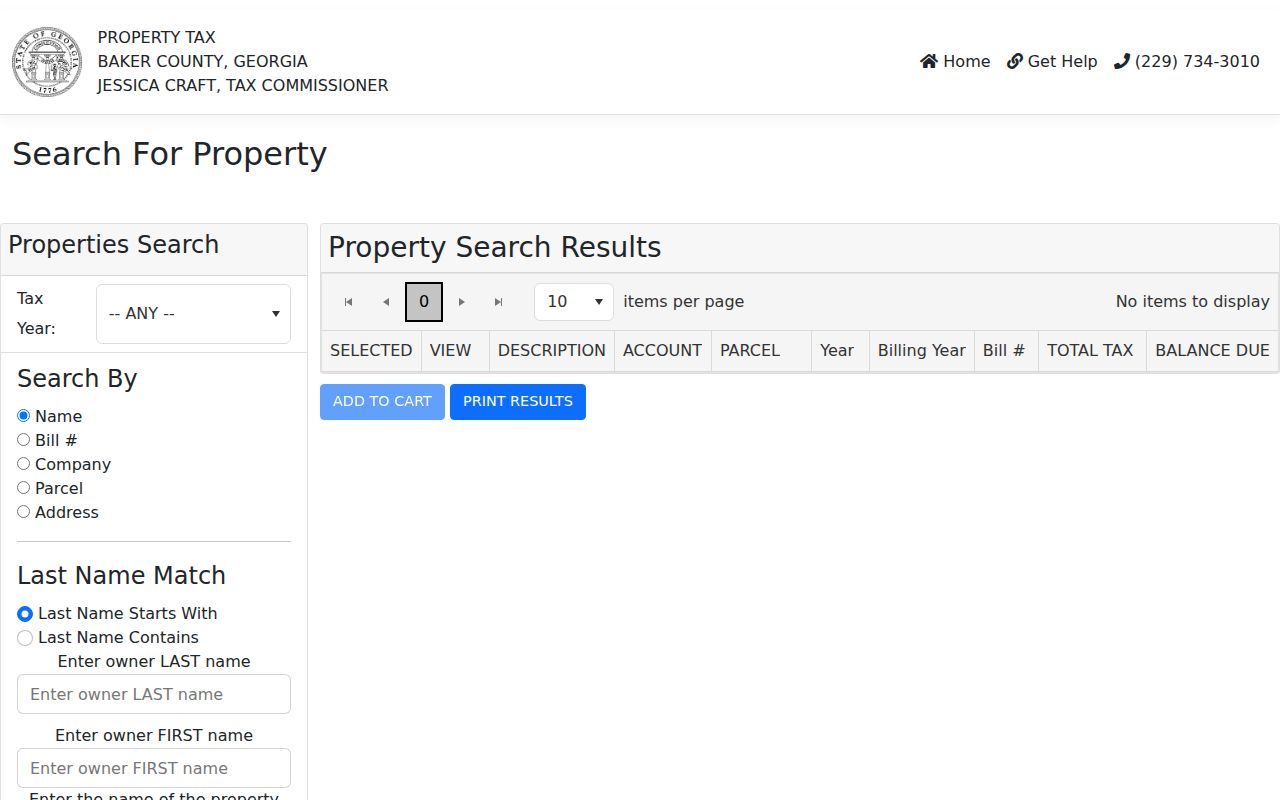
The multiple modes are useful when the mailing name differs from the situs address.
Baker Assessor Versus Commissioner
The Baker qPublic assessor page publishes the digest and describes field review. The Tax Commissioner handles billing and collection. Take a value correction to the assessor. Take a paid, due, or delinquent account question to the Commissioner. Review the assessor source directly for the office's own details.
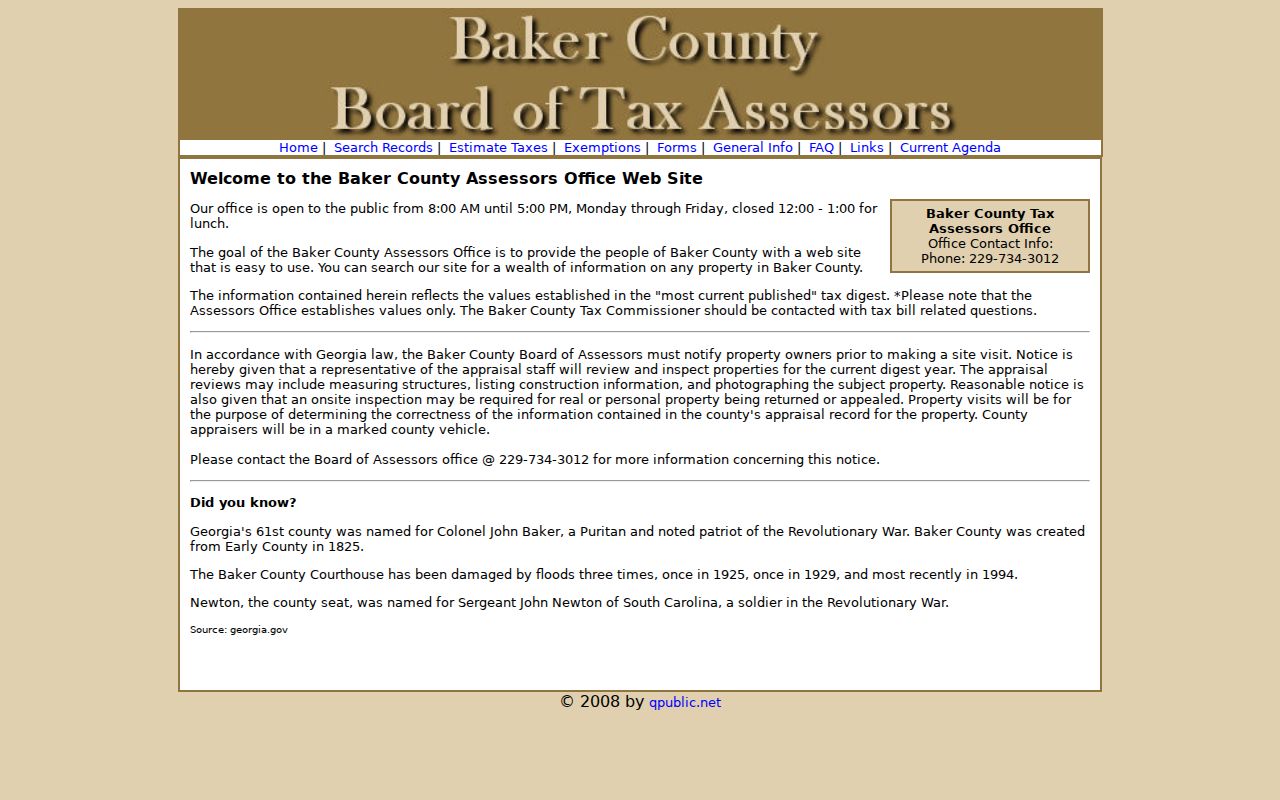
The distinction prevents a tax-payment issue from being sent to the value-setting office.
Baker's Forty Percent Rule
Georgia law generally assesses property at 40 percent of fair-market value. Baker's general-information page sets January 1 as the valuation date. After lawful exemptions, the millage rate applies to that assessed value.
| Stage | Meaning |
|---|---|
| Fair-market value | Assessor's value as of January 1 |
| Assessment ratio | Generally 40 percent |
| Exemptions | Qualifying relief applied to the account |
| Millage | Rate used to calculate tax |
The bill shows what a taxpayer owes, not what a buyer would pay. It is no substitute for a private appraisal either.
Baker Homestead Exemption Timing
Baker's published guidance names homestead relief and senior programs. The assessor can confirm current amounts. Eligibility and filing rules matter. Never infer an exemption from an owner's age. Never infer it from a mailing address or a prior owner's record.
Search the same tax year and assessment year throughout. If a relief entry is missing, ask when the application was filed. Ask which year it affects and whether a denial notice opened appeal rights.
Baker Property Tax Calendar
Fair-market value is set as of January 1. Baker's published due date is December 20. Monthly delinquent interest begins December 21, followed by the county's notice and FIFA process. Returns, assessment notices, appeals, bills, and delinquency are separate events, so save each date.
A return reports the owner's position; it does not set the final value. An assessment notice concerns value or taxability. The Tax Commissioner then applies the final digest and rates to billing.
Baker Tax-Sale Status Changes
The official Baker tax-sales page posts the county's current sale status. It can read "No tax sales at this time." Treat that as a live status rather than a permanent answer. Check the page and call the Tax Commissioner before relying on it.
A delinquent bill, a FIFA, an advertised sale, a sale deed, and the final ownership outcome are separate records. Verify each step with its custodian. Do not read one web notice as the whole chain.
Baker Tax Record Limits
A tax bill does not prove clear title. It does not prove occupancy, a legal boundary, or current market price. The mailing address is simply where notices go. The situs address is the physical tax location. For ownership questions, the current deed and legal description answer more directly.
For portal trouble, call the Tax Commissioner at 229-734-3010, weekdays 8 a.m. to 4:30 p.m. The Tax Assessor at 229-734-3012 handles value and exemption questions. Both offices sit at 167 Baker Place in Newton. Existing records may also be requested under the Georgia Open Records Act.
Check Baker Tax Records Carefully
Keep a tax notebook. Record the parcel number, tax year, bill number, assessment year, and owner spelling. Add the situs, mailing line, exemptions, value, balance, and the date you accessed each record. These fields change on different schedules. A just-recorded deed can beat the assessor's update, and an assessor correction may never reach an older bill.
When figures disagree, ask the owning office. The Tax Assessor controls value, taxability, exemptions, equalization, and the digest. The Tax Commissioner handles billing, collections, delinquency, executions, and tax-sale administration. Cite the notice or bill year in every request. For an appeal, keep the envelope, assessment notice, photos, repair estimates, comparable sales, and proof of filing; for payment status, request a current account statement rather than trusting an old printout.
Use lawful public records only for the property question at hand. A mailing address may not be the owner's home. Protected data can be redacted under Georgia law. Never defeat Safe At Home or another valid protection. Before a purchase, sale, appeal, or title decision, confirm each material finding with the custodian of that record.
Read Baker Delinquency Stages
Past due does not mean sold. Baker's general information sets the tax due date at December 20, with monthly interest starting December 21. From there the process can move through notice, a FIFA execution, advertisement, levy, sale, and later recorded instruments. Each stage carries its own date and custodian. Ask the Tax Commissioner for the balance and status. Then use the Clerk's index for any recorded lien, cancellation, tax sale deed, or related court filing.
| Record | Question it answers |
|---|---|
| Tax account | What is billed, paid, or due for a year? |
| FIFA or lien | Was an execution or claim recorded? |
| Sale notice | Was a sale announced for a stated date? |
| Tax sale deed | What resulting instrument was recorded? |
The sales list is only a snapshot. Save the date and confirm the listing by phone. Do not infer ownership from a delinquent label or advertisement, because the deed chain and any legal proceedings must be checked separately.
Baker Assessment Evidence
A strong value review compares like property and ties every item to the assessment date. Start with the notice, parcel card, and legal description. Add the land and improvement facts, exemption status, and any photos or sketches from the assessor. Then gather recent comparable sales, documented damage, repair estimates, or a qualified appraisal. A neighbor's lower bill may just reflect different acreage, improvements, exemptions, or a tax year.
Uniformity asks whether similar property is treated consistently. Taxability asks whether the interest is taxable at all. Value targets the assessor's fair-market conclusion. An exemption appeal concerns qualification or relief. State the ground clearly; a payment posting problem belongs with the Tax Commissioner, not the Board of Tax Assessors.
The qPublic page places normal field visits from January 1 through May 1. It flags ownership changes in the last 12 months, mobile-home permits or returns, and appeals as review targets. A field visit is appraisal work. It is not proof of any value outcome. Ask for the record and date behind any change. File the appeal within 45 days of the notice, keep a full copy, and preserve evidence of delivery.
Print the current result before paying or appealing. Note the access date. A saved copy makes later corrections, posting delays, and year-to-year changes easier to explain. For written questions, include the parcel number and tax year, say whether the issue is value or payment, and ask for the existing record supporting the answer. A narrow request reaches the right Baker office.